Social Listening for Audience Insights
Uncategorized

How to Use Social Listening to Understand Your Audience and Improve Your Marketing

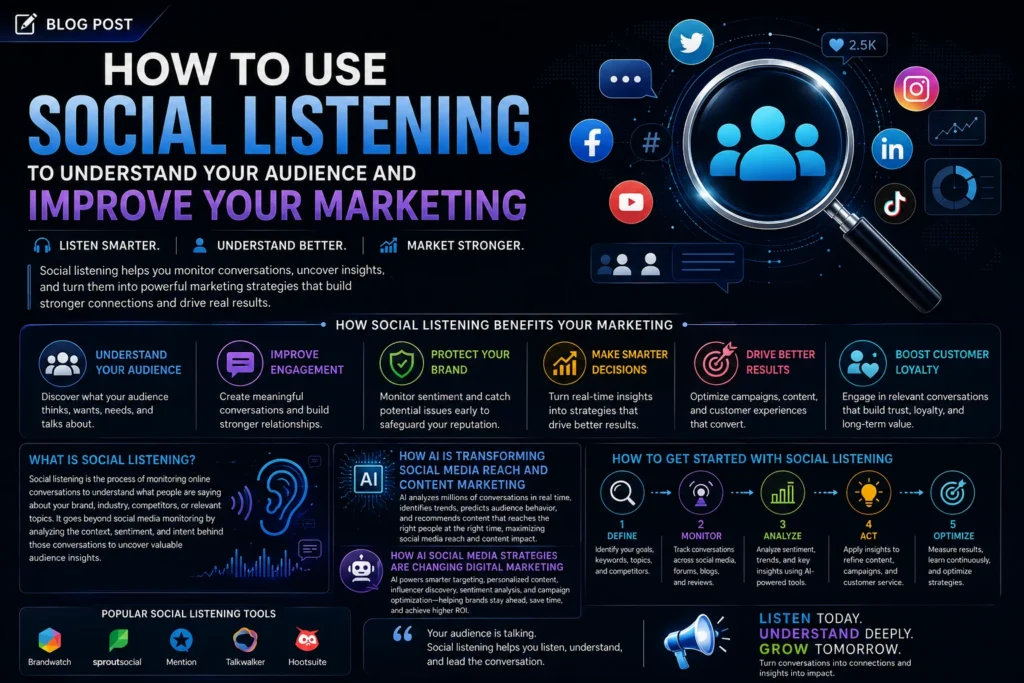
Social Listening for Audience Insights Why Social Listening Is Reshaping Modern Marketing People share their likes, dislikes, complaints, and expectations openly across social platforms every single day. Brands that pay close attention to these conversations unlock insights that sharpen their marketing decisions. This practice — social listening — turns casual online chatter into real business intelligence. It goes well beyond simply noting when a brand gets mentioned; it helps marketers spot rising trends, gauge how customers really feel, study what competitors are doing, and understand audience behavior as it happens. In a fast-moving digital landscape, companies that lean into social listening make choices grounded in real customer conversations instead of guesswork — and that gives them a lasting edge over competitors who still rely on assumptions and outdated research cycles. What Social Listening Actually Means Social listening means tracking online discussions tied to your brand, your products, your competitors, your industry, and related keywords. Where standard social media monitoring mostly counts things — mentions, likes, shares — social listening digs into the meaning behind those interactions. It surfaces customer pain points, common questions, and shifting preferences early, often before they turn into full-blown trends. This distinction matters because raw numbers alone rarely tell the full story. A spike in mentions could mean excitement about a new product launch, or it could mean customers are venting about a service outage. Only by digging into the actual content of the conversation can a brand tell the difference. That head start — knowing not just that people are talking, but what they’re actually saying — lets marketers fine-tune campaigns, refine products, and craft content that actually lands with their audience, which in turn deepens engagement and boosts overall performance across every stage of the customer journey. Monitoring vs. Listening: Not the Same Thing The two terms get used interchangeably, but they’re not equivalent. Monitoring is mostly about numbers — mentions, comments, hashtags, follower counts — useful for tracking performance but weak on explaining the “why” behind customer behavior. It tells you that something happened, not why it happened or what to do about it. Listening interprets tone, intent, and context: is the audience happy, annoyed, thrilled, let down? It asks what’s driving the sentiment, not just how much of it there is. That deeper read helps businesses improve messaging, customer service, and marketing strategy in ways raw metrics can’t. A brand that only monitors might notice comment volume doubling after a product update; a brand that listens will know within hours whether that spike is enthusiasm or backlash, and can respond accordingly rather than reacting blind. A Sharper Picture of Your Audience People tend to be far more candid on social media than they are in formal surveys, so listening in gives brands unfiltered feedback on pricing, service quality, and product experience. Survey responses are filtered through the awareness that someone is watching; social posts, comments, and reviews are often written in the moment, with none of that self-consciousness, which makes them a richer and more honest data source. It also reveals demographic interests, preferred content styles, buying motivations, and recurring frustrations — all of which feed into more personalized campaigns. Instead of guessing which messaging will resonate with a given segment, marketers can build campaigns directly from the language, concerns, and interests that audience already uses. Campaigns that feel personal build stronger emotional connections, and those connections tend to translate into loyalty, better conversion rates, and stronger retention over the long run — outcomes that are far harder to achieve through generic, one-size-fits-all messaging. Protecting Brand Reputation in Real Time Reputation management is a constant job, not a one-time project. A single wave of negative sentiment can spread fast enough to damage trust within hours, especially when a post or complaint goes viral before a brand even notices it exists. Social listening lets brands catch problems early, before they snowball into full PR crises that require damage control instead of simple correction. It also highlights recurring complaints so they can be fixed at the source rather than addressed one customer at a time. If dozens of people are independently describing the same friction point — a confusing checkout flow, a shipping delay, a support line that’s hard to reach — that pattern is far easier to spot through listening than through scattered, individual complaint tickets. Fast, transparent responses to customer concerns demonstrate accountability and build credibility over time, strengthening relationships with both existing and prospective customers who are watching how a brand handles adversity. Turning Conversations Into Real Engagement Good marketing isn’t just broadcasting promotions — it’s joining conversations that actually matter to the audience. Listening reveals the topics people care about, so brands can create discussions instead of one-sided ads that customers scroll past without a second thought. It also surfaces common questions and misconceptions, which can be turned into helpful videos, blog posts, and social content that speaks directly to what people want to know. Rather than guessing at content topics, marketers can build an entire content calendar around the actual questions and confusion points their audience is already voicing online. The payoff is engagement that grows organically, because people feel genuinely heard rather than marketed at — and audiences are far more likely to share, comment, and return to a brand that seems to be listening to them. AI’s Growing Role in Social Listening AI has changed the scale and speed of conversation analysis dramatically. Tools now process massive volumes of posts, comments, and reviews in seconds, delivering insights far faster than manual review ever could — a task that would take a human analyst weeks can now be summarized in minutes. This shift reflects a broader move toward AI reshaping how brands extend their reach and build content strategy from the ground up. AI can flag emerging topics before they trend, forecast audience interest based on early conversation patterns, read sentiment across multiple languages and platforms simultaneously, and suggest content directions based on live behavioral signals rather
AI-Powered Content Marketing
Uncategorized

How to Map Your Content to the Customer Journey Using AI

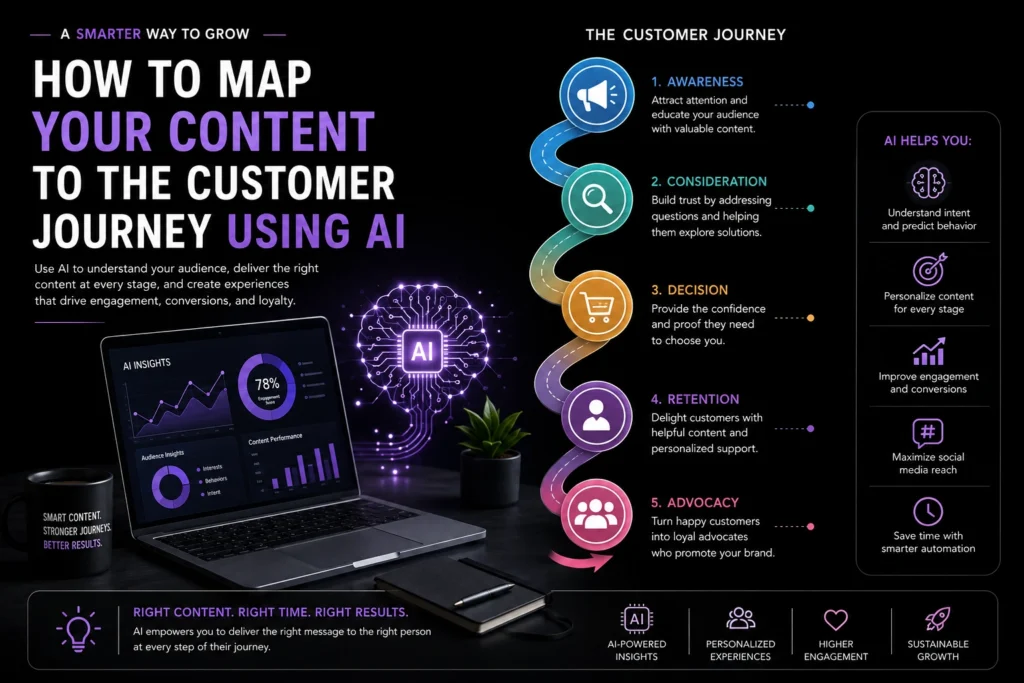
AI-Powered Content Marketing Mapping Content to the Customer Journey with AI: A Complete Guide In today’s crowded digital marketplace, generic content no longer cuts through the noise. Audiences expect brands to understand where they are in their buying process and to respond with information that actually fits that moment. Artificial intelligence has become the engine that makes this kind of responsiveness possible at scale — helping marketers decode customer intent, anticipate future behavior, and serve the right message at the right time, from the very first search query to years of repeat loyalty. AI has also reshaped how brands approach social platforms. It surfaces what audiences actually care about, sharpens organic reach, lifts engagement, and takes much of the manual effort out of content production. As expectations keep climbing, using AI to align content with each phase of the customer journey gives businesses a way to deepen relationships, lift conversion, and get more value out of every marketing dollar. Below, we walk through how organizations can build that alignment stage by stage — and where AI fits into each one. Section 1: Know the Journey Before You Build the Content No content strategy succeeds without first understanding the path a customer actually walks. That path — commonly broken into five phases: Awareness, Consideration, Decision, Retention, and Advocacy — represents everything a person experiences before, during, and after buying. Each phase brings its own set of questions, doubts, and expectations, which means a single piece of messaging can’t realistically serve all of them. Matching content to each phase is what makes every touchpoint feel useful instead of intrusive. Early on, people respond well to explainer blog posts and short educational videos. As they get closer to a decision, comparison charts, case studies, and customer testimonials carry more weight. Once someone becomes a customer, the job shifts to onboarding support, product education, and content that reinforces their choice. Brands that map their content this deliberately tend to build deeper trust and hold on to customers far longer than those relying on one-size-fits-all campaigns. Section 2: How AI Rewrote the Rules of Journey Mapping Journey mapping used to be a slow, largely manual exercise — surveys, interviews, spreadsheets of historical purchase data. That approach still has value, but it’s resource-heavy and often lags behind how customers actually behave in real time. AI changes the math entirely, sifting through enormous volumes of behavioral data in moments and surfacing patterns that would take a human analyst weeks to find, if they found them at all. Machine learning models now absorb signals continuously — from site visits, email opens, search behavior, and activity on social platforms — building an increasingly precise picture of what each audience segment wants next. That precision lets marketing teams move from guesswork to evidence: recommending content dynamically, timing publication for maximum visibility, and adjusting social strategy on the fly. Rather than assuming what will land, teams can let the data tell them, and adjust before a campaign underperforms rather than after. Section 3: Sparking Awareness with Smarter Educational Content Awareness is where the journey begins — a moment when someone has noticed a problem or an opportunity but hasn’t yet identified how to solve it. This is not the moment for a sales pitch. It’s the moment for content that teaches: explainer articles, infographics, short-form video, podcasts, and social posts that establish credibility before asking for anything in return. AI sharpens this stage by spotting trending topics, surfacing keywords with real traction, and flagging shifts in what audiences are searching for before those shifts become obvious. Social listening tools go further, recommending optimal posting windows and the content formats most likely to perform with a given segment. The result is a much tighter feedback loop — instead of publishing and hoping, marketers can publish based on where attention is already heading, improving reach and engagement without multiplying their workload. Section 4: Supporting Buyers Through Consideration Once someone recognizes their problem, they start comparing solutions — reading reviews, weighing features, checking pricing, and looking for proof that a product will actually deliver. This is the moment for substance: in-depth comparisons, detailed case studies, webinars, downloadable guides, and FAQ content that tackles objections head-on rather than dancing around them. AI adds a layer of relevance that generic content can’t match. If a prospect has been reading about marketing automation, for example, a recommendation engine can surface deeper resources on that exact topic rather than a broad overview they’ve already outgrown. Predictive models go a step further, flagging which specific assets historically correlate with a completed purchase, so teams can prioritize producing more of what actually moves people forward. The net effect is a Consideration stage that feels tailored rather than templated — which builds the kind of confidence that shortens the path to a decision. Section 5: Closing the Deal with Personalized Experiences By the time someone reaches the Decision stage, they’re weighing a final choice — and any lingering uncertainty can stall them indefinitely. This is where testimonials, live demos, transparent pricing, case studies, and low-risk offers like free trials do the heaviest lifting. The goal is simple: remove friction and make the “yes” feel obvious. AI supports this in several concrete ways. Dynamic website experiences can shift content and offers based on a visitor’s prior behavior, while recommendation engines surface the specific product or plan most likely to fit. AI-driven chat tools handle questions instantly, day or night, guiding hesitant visitors toward the information they need without the delay of a human support queue. On the paid side, AI models continuously evaluate which campaigns are actually converting, letting teams shift budget toward what’s working instead of waiting for a quarterly report to find out. Section 6: Keeping Customers Engaged After the Sale A completed purchase isn’t a finish line — it’s the start of a new relationship. Companies that treat it that way keep investing in the customer through onboarding materials, help-center content, video tutorials, email updates, and personalized product

AI in social media marketing
Uncategorized

How AI Is Changing the Rules of Social Media Reach: The Future of Smarter Digital Marketing

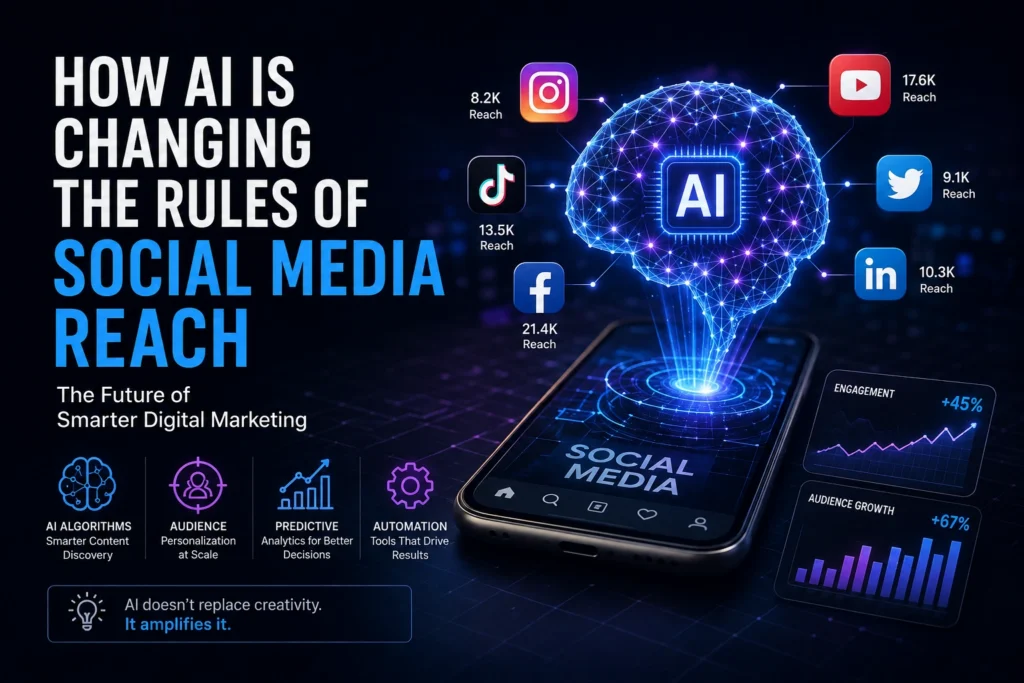
AI in social media marketing How AI Quietly Took Over Social Media Growth Introduction A decade ago, growing an audience online was mostly a numbers game. Post often, chase the right hashtags, hit the “ideal” posting time, and reach would follow. That playbook is largely obsolete. Social platforms have quietly rebuilt themselves around artificial intelligence. The systems now deciding what gets seen operate on a completely different logic than the one marketers grew up with. For anyone building a brand, a following, or a business online, understanding this shift isn’t optional anymore. It’s the baseline. Platforms pour enormous resources into machine learning because it keeps people scrolling longer. The systems they’ve built read audience behavior with a precision that would have been unthinkable ten years ago. Every scroll, pause, replay, and skip becomes a signal. Companies that learn to work with these signals, rather than against them, end up with a real edge. This piece breaks down what actually changed, why old tactics stopped working, and how creators and marketers can adjust — including where the right AI-powered tools fit in. Section 1: What AI Is Actually Doing Behind the Scenes At its core, artificial intelligence means software that can learn patterns from data and make predictions without being explicitly programmed for every scenario. On social platforms, this shows up in recommendation systems, content moderation, personalized feeds, and ad targeting. It isn’t following a fixed script. It’s constantly updating its understanding based on fresh behavior. Every like, comment, saved post, shared link, and even how long someone hovers over a piece of content becomes training data. Multiply that across millions of users and you get a system that can predict, with startling accuracy, what a specific person wants to see next. The practical takeaway: reach is no longer primarily about who follows you. It’s about how content performs against real audience behavior, including people who’ve never heard of you before. Section 2: Why the Old Growth Playbook Has Lost Its Power For years, the standard advice was simple: post consistently, use a stack of trending hashtags, and publish at the “right” time. None of that is technically wrong. But none of it is sufficient anymore either. Those tactics assumed distribution followed predictable, mechanical rules. AI-driven platforms don’t work that way. Instead of rewarding activity for its own sake, algorithms ask a sharper question: does this content actually hold attention and prompt real interaction? A post published at a “perfect” time that nobody engages with will still sink. A post published at an “off” hour that sparks real interest will often outperform it. Timing and hashtags haven’t disappeared as factors. They’ve just been demoted from primary levers to minor adjustments. The center of gravity has shifted toward content quality and audience response. This is a hard adjustment for marketers trained on the old rules. It can feel like the ground keeps moving. But the shift also levels the playing field in a real way. A small account with genuinely strong content can now outrun a large account coasting on habit. Size alone no longer buys guaranteed visibility. Section 3: Algorithms Are Built to Chase Genuine Value One major shift is how quickly platforms can now spot content that’s actually useful or entertaining, versus content that just exists. Within moments of publishing, algorithms track behavioral signals: how long someone watches, whether they read to the end, whether they scroll past immediately, or whether they stop to comment. When people spend more time with something, the system reads that as a strong quality signal and pushes it to a wider audience. That’s why content that teaches, solves a problem, or genuinely entertains tends to outperform purely promotional posts. People vote with their attention, and the algorithm notices. This creates an opening for smaller creators and lean-budget businesses. It’s now possible to earn real organic reach without heavy ad spend, as long as the content genuinely resonates. Value, not follower count, increasingly drives visibility. Section 4: Personalization Has Become the Default Expectation Personalized content used to be a nice extra. Now it’s simply expected. Every individual’s feed is effectively a custom-built experience, shaped by that person’s viewing habits, interests, and interaction history. No two users see quite the same version of a platform. This changes how marketing has to work. Broadcasting one generic message to an entire audience is a much weaker strategy than it used to be. The strongest results tend to come from brands that build content for specific audience segments — tailoring tone, format, and message to a particular group instead of trying to speak to everyone at once. In practice, this might mean producing several versions of a campaign for different audience slices, leaning into niche topics over broad ones, or using formats that make viewers feel the content was made just for them. The narrower and more relevant it feels, the more likely the algorithm keeps showing it to similar people. This doesn’t mean abandoning a broader brand identity. It means layering specific, segment-aware content on top of that identity. A single message can still exist. It just needs supporting variations that speak directly to the different groups a brand actually serves. Section 5: Where AI-Powered Marketing Tools Fit In As algorithms have grown more sophisticated, so has the toolkit marketers use to keep pace. AI-assisted platforms now help with idea generation, caption drafting, scheduling, and deep audience analysis — work that used to take teams hours to do by hand. The real value here isn’t automation for its own sake. It’s the ability to surface insights that would otherwise stay buried in raw data. A good analytics tool can flag which posts are overperforming, spot patterns in what an audience responds to, and warn early when content is falling flat so adjustments can happen fast. Used well, these tools free up time for the parts of marketing that still need a human touch — voice, creativity, judgment — while handling the repetitive analytical grind in the background.

Scroll to Top