Uncategorized

Uncategorized

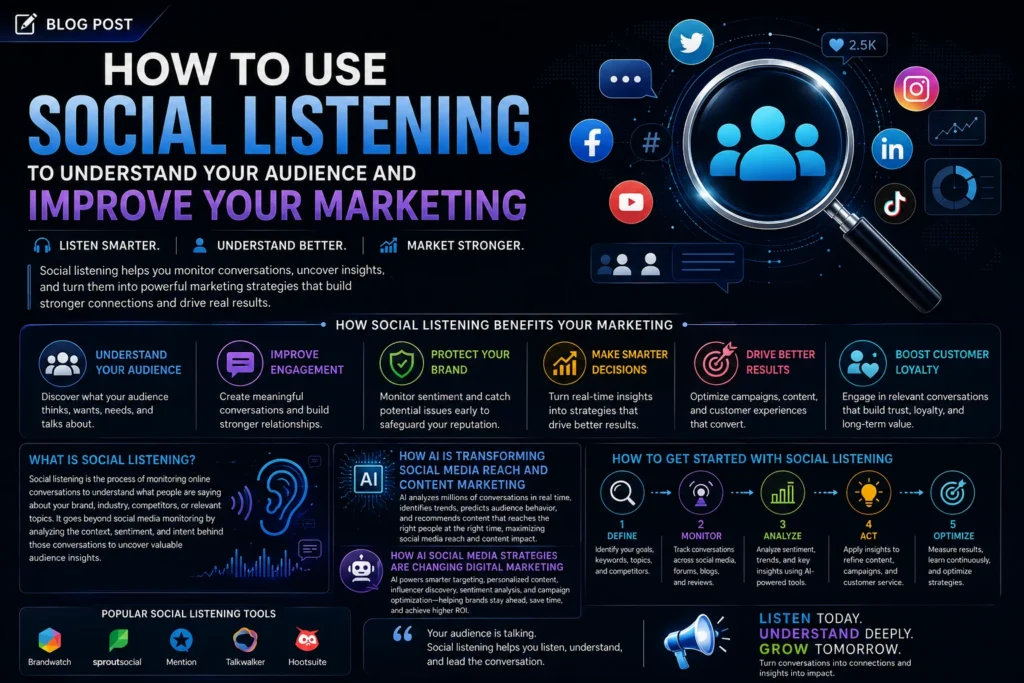
How to Use Social Listening to Understand Your Audience and Improve Your Marketing

Unlocking Customer Conversations to Build Smarter Marketing Strategies 1. Introduction: Why Social Listening Has Become a Marketing Necessity In today’s highly competitive digital landscape, businesses must understand their customers beyond traditional surveys and website analytics. Consumers constantly express their opinions, preferences, frustrations, and expectations across social media platforms. Therefore, organizations that actively monitor these conversations gain valuable insights that help improve their marketing strategies. This process, known as social listening, allows brands to transform everyday online discussions into actionable business intelligence. Moreover, social listening goes beyond simply tracking brand mentions. It enables marketers to identify emerging trends, measure customer sentiment, discover competitor strategies, and understand audience behavior in real time. As digital marketing continues to evolve, businesses that embrace social listening gain a competitive advantage by making informed decisions based on authentic customer conversations rather than assumptions. 2. Understanding Social Listening and Why It Matters Social listening is the process of monitoring online conversations related to your brand, products, competitors, industry, and relevant keywords. Unlike basic social media monitoring, which focuses primarily on collecting mentions and engagement metrics, social listening analyzes the meaning behind these conversations to uncover valuable audience insights. Furthermore, businesses can identify customer pain points, frequently asked questions, and changing consumer preferences before they become major trends. Consequently, marketers can adjust campaigns, improve products, and create more relevant content that resonates with their target audience. This proactive approach significantly strengthens customer engagement while improving overall marketing performance. 3. The Difference Between Social Media Monitoring and Social Listening Although many marketers use these terms interchangeably, they represent different marketing practices. Social media monitoring primarily focuses on collecting measurable data such as mentions, likes, comments, shares, hashtags, and follower growth. These metrics provide useful performance indicators but often fail to explain why customers behave in certain ways. On the other hand, social listening interprets emotions, opinions, customer intent, and conversation context. Instead of simply counting comments, businesses analyze whether customers feel satisfied, frustrated, excited, or disappointed. As a result, organizations gain deeper audience insights that help improve messaging, customer service, and overall marketing effectiveness. 4. How Social Listening Helps You Understand Your Audience Better One of the greatest advantages of social listening is its ability to reveal genuine customer opinions. People often discuss products more openly on social media than they do in surveys. Therefore, brands receive honest feedback about pricing, customer service, product quality, and user experience. Additionally, marketers can identify demographic interests, preferred content formats, purchasing motivations, and common challenges faced by their audiences. These insights enable businesses to create highly personalized marketing campaigns that connect with customers on a deeper emotional level. Consequently, stronger relationships lead to increased loyalty, higher conversion rates, and improved customer retention. 5. Improving Brand Reputation Through Social Listening Maintaining a positive brand reputation requires continuous awareness of public perception. Negative comments can spread rapidly across social media platforms, potentially damaging customer trust within hours. However, social listening enables brands to detect issues early and respond before they escalate into larger public relations challenges. Moreover, businesses can identify recurring customer complaints and resolve them efficiently. Responding promptly to customer concerns demonstrates transparency and commitment to customer satisfaction. Over time, this proactive communication builds trust, strengthens credibility, and reinforces long-term relationships with existing and potential customers. 6. Strengthening Customer Engagement with Meaningful Conversations Successful marketing extends beyond publishing promotional content. Instead, businesses must actively participate in conversations that matter to their audiences. Through social listening, marketers discover topics customers genuinely care about, allowing brands to create valuable discussions rather than one-way advertising messages. Furthermore, analyzing audience conversations helps companies identify frequently asked questions, common misconceptions, and trending interests. Businesses can then develop educational content, helpful videos, informative blogs, and engaging social media posts that directly address customer needs. As a result, customer engagement naturally increases because audiences feel heard, understood, and valued. 7. Using AI to Enhance Social Listening Capabilities Artificial intelligence has significantly transformed the way businesses analyze customer conversations. Modern AI-powered tools process millions of social media posts, reviews, comments, and discussions within seconds. Consequently, marketers receive faster and more accurate insights than manual analysis could ever provide. This transformation perfectly illustrates How AI Is Transforming Social Media Reach and Content Marketing. AI identifies trending topics, predicts audience interests, analyzes customer sentiment, and recommends optimal content strategies based on real-time behavioral patterns. Instead of relying solely on historical data, marketers can now make proactive decisions supported by predictive analytics and machine learning technologies. Additionally, businesses increasingly recognize How AI Social Media Strategies Are Changing Digital Marketing by automating audience segmentation, content recommendations, influencer identification, and engagement optimization. AI not only saves time but also enables marketers to deliver personalized experiences that improve campaign performance across multiple digital platforms. 8. Gaining a Competitive Advantage Through Competitor Analysis Social listening provides valuable intelligence beyond your own brand. By monitoring competitor conversations, businesses can identify strengths, weaknesses, customer complaints, and successful marketing campaigns. This information helps marketers discover opportunities that competitors may have overlooked. Moreover, competitor analysis allows organizations to benchmark performance, compare customer satisfaction levels, and identify emerging industry trends before they become mainstream. Consequently, businesses can refine their strategies, differentiate their offerings, and position themselves more effectively within competitive markets. 9. Creating Better Content with Audience Insights Content marketing becomes significantly more effective when based on authentic customer conversations. Rather than guessing what audiences want, marketers can use audience insights gathered through social listening to develop content that answers real questions and solves genuine problems. Additionally, social listening reveals trending keywords, popular hashtags, common customer concerns, and frequently discussed topics. These insights help marketers produce highly relevant blogs, videos, podcasts, webinars, and social media content that attract higher engagement while improving search engine visibility. Consequently, businesses maximize both organic reach and customer satisfaction. 10. Measuring Marketing Success with Social Listening Data Effective marketing requires continuous measurement and optimization. Social listening provides valuable metrics beyond traditional engagement statistics by tracking customer sentiment, conversation volume, share of voice, brand perception, and emotional responses

Uncategorized

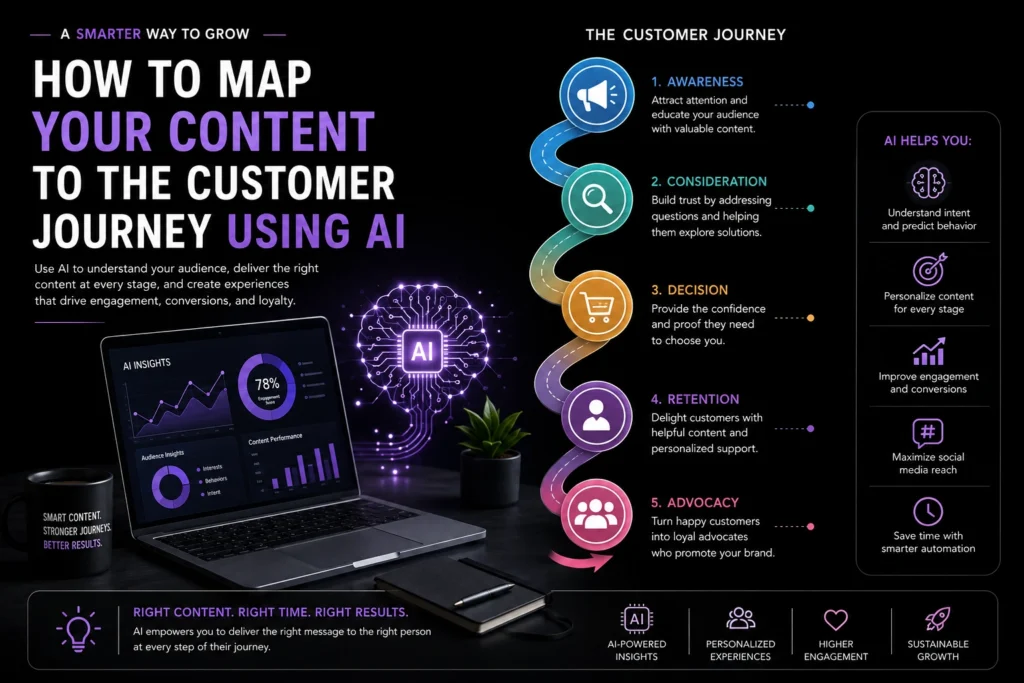
How to Map Your Content to the Customer Journey Using AI

Introduction: Transforming Customer Experiences with AI-Powered Content In today’s competitive digital landscape, businesses can no longer rely on generic content to attract and retain customers. Instead, organizations must deliver relevant, personalized, and timely information that aligns with every stage of the customer journey. Fortunately, artificial intelligence (AI) has transformed the way marketers understand customer behavior, create personalized experiences, and optimize content marketing strategies. By leveraging AI algorithms, businesses can analyze customer intent, predict future actions, and provide content that resonates with audiences from awareness to advocacy. Moreover, AI has become an essential component of modern AI social media strategies. It helps brands identify audience preferences, improve social media reach, increase engagement, and streamline content creation. As consumer expectations continue to evolve, mapping content to the customer journey using AI enables businesses to build stronger relationships, improve conversion rates, and maximize return on investment. This guide explores how organizations can strategically align content with each stage of the customer journey while using AI to create meaningful customer experiences. Section 1: Understanding the Customer Journey Before Creating Content Every successful marketing campaign begins with a clear understanding of the customer journey. The customer journey represents the complete path a person follows before, during, and after purchasing a product or service. Typically, this journey consists of five major stages: Awareness, Consideration, Decision, Retention, and Advocacy. Each stage reflects different customer needs, questions, and expectations. Therefore, marketers must develop content that addresses these changing requirements rather than relying on one-size-fits-all messaging. Furthermore, mapping content to these stages ensures that every interaction provides value. Educational blog posts and informative videos work well during the Awareness stage, while comparison guides, case studies, and testimonials become more effective during the Consideration and Decision stages. After customers make a purchase, businesses should continue delivering helpful content that supports onboarding, customer success, and loyalty. Consequently, companies that align content with the customer journey create stronger relationships and encourage long-term engagement. Section 2: Why Artificial Intelligence Changes Content Mapping Forever Artificial intelligence has fundamentally changed how marketers approach customer journey mapping. Previously, marketers relied heavily on manual research, surveys, and historical data to understand audience behavior. Although these methods still provide value, they often require significant time and resources. AI dramatically improves this process by analyzing massive datasets within seconds and identifying patterns that humans might overlook. Additionally, AI algorithms continuously learn from customer interactions across websites, email campaigns, search engines, and AI social media platforms. As a result, businesses gain deeper insights into audience preferences, browsing behavior, and purchasing intent. These insights enable marketers to create personalized content recommendations, optimize publishing schedules, and improve social media strategy across multiple channels. Instead of making assumptions, organizations can confidently use AI-driven insights to deliver highly relevant experiences that increase customer satisfaction and conversion rates. Section 3: Building Awareness with AI-Driven Educational Content The Awareness stage represents the beginning of the customer journey. At this point, potential customers recognize a problem or opportunity but may not yet know the best solution. Therefore, businesses should focus on creating educational content rather than promotional material. Blog posts, infographics, podcasts, videos, and social media content help audiences discover valuable information while building trust with the brand. AI significantly enhances Awareness-stage content by identifying trending topics, high-performing keywords, and emerging customer interests. Furthermore, AI social media tools analyze audience behavior to recommend the most effective publishing times and content formats. Consequently, marketers can improve social media reach, attract more qualified visitors, and increase engagement through personalized content recommendations. Instead of guessing what audiences want, AI empowers marketers to make informed content decisions based on real-time data. Section 4: Guiding Prospects Through the Consideration Stage During the Consideration stage, customers actively compare different solutions before making a purchase decision. They seek trustworthy information that helps them evaluate products, services, pricing, and overall value. Therefore, businesses should provide detailed comparison guides, case studies, webinars, white papers, FAQs, and product demonstrations. This content should answer important questions while addressing common concerns and objections. AI makes this stage even more effective by personalizing content recommendations according to customer interests and previous interactions. For example, if a visitor frequently reads articles about digital marketing automation, AI can recommend advanced resources related to automation tools and strategies. Moreover, predictive analytics identify which content pieces are most likely to influence purchasing decisions. Consequently, businesses improve customer confidence, strengthen brand credibility, and increase conversion opportunities through relevant content marketing initiatives. Section 5: Driving Purchase Decisions with Personalized AI Experiences The Decision stage represents the point where customers are ready to choose a solution. At this stage, businesses must eliminate uncertainty while reinforcing trust. Customer testimonials, product demonstrations, pricing pages, success stories, free trials, and personalized consultations all help customers make informed purchasing decisions. Every piece of content should clearly communicate value while simplifying the buying process. Artificial intelligence enhances decision-making by delivering personalized offers, dynamic website experiences, and intelligent product recommendations. Additionally, AI chatbots provide instant assistance, answer customer questions, and guide users toward appropriate solutions without delay. These AI-powered interactions reduce friction throughout the buying process while improving customer satisfaction. As businesses continue optimizing their social media strategy, AI also helps identify which promotional campaigns generate the highest engagement and conversion rates, allowing marketers to allocate resources more effectively. Section 6: Strengthening Customer Retention Through AI-Powered Personalization Customer relationships should not end after a purchase. Instead, successful businesses continue nurturing customers by providing valuable content that helps them maximize the benefits of their purchase. The Retention stage focuses on improving customer satisfaction, encouraging repeat purchases, and building long-term loyalty. Businesses can achieve these objectives through onboarding guides, knowledge base articles, tutorial videos, email newsletters, personalized product recommendations, and exclusive educational resources. Artificial intelligence makes customer retention significantly more effective by continuously analyzing user behavior after conversion. For example, AI identifies which customers are most likely to disengage and recommends proactive communication before they lose interest. Additionally, personalized email campaigns, product suggestions, and automated customer support improve the overall customer experience. As a

Uncategorized

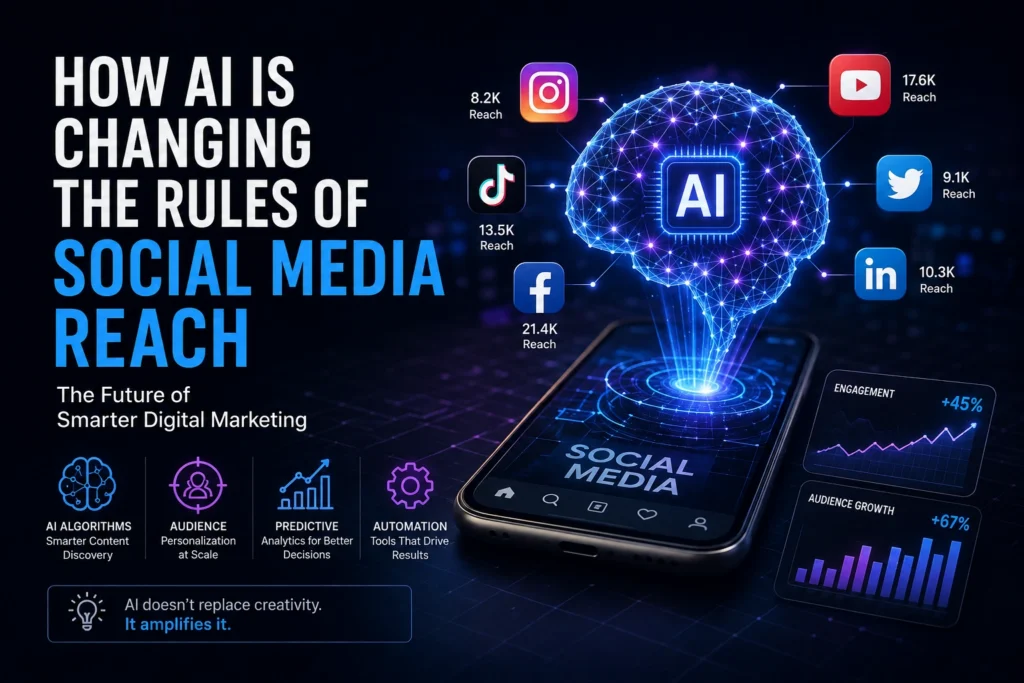
How AI Is Changing the Rules of Social Media Reach: The Future of Smarter Digital Marketing

Introduction: The New Era of Social Media Success Social media has evolved dramatically over the last decade. What once relied heavily on consistent posting schedules and trending hashtags has now become a sophisticated ecosystem powered by artificial intelligence. Today, brands, creators, and marketers must understand how AI is reshaping the way content is discovered, distributed, and consumed. As a result, mastering AI social media reach has become a necessity rather than an option. Moreover, social media platforms continue to invest heavily in artificial intelligence to improve user experience. Algorithms now analyze user behavior, preferences, engagement history, and viewing patterns with remarkable precision. Consequently, businesses that adapt to these AI-driven systems gain a significant competitive advantage. This article explores how AI is changing the rules of social media reach and how marketers can stay ahead by embracing innovation and using powerful AI marketing tools. Section 1: Understanding AI in Social Media Artificial intelligence refers to computer systems that can perform tasks requiring human intelligence, including learning, prediction, language understanding, and decision-making. Within social media, AI powers recommendation engines, content moderation, personalized feeds, advertising systems, and audience targeting. Therefore, every interaction on a platform contributes valuable data that AI uses to improve future recommendations. Furthermore, AI continuously learns from user activity instead of relying on fixed rules. It studies what users watch, like, comment on, save, and share. As a result, platforms become increasingly effective at delivering content that users are most likely to engage with. This intelligent personalization directly influences AI social media reach, making content quality more important than follower count alone. Section 2: Why Traditional Reach Strategies No Longer Work In the past, marketers focused primarily on posting at the perfect time, using numerous hashtags, and publishing frequently. Although these tactics still offer some value, they no longer guarantee visibility. Instead, AI evaluates whether content genuinely deserves wider distribution based on audience behavior. Section 3: AI Rewards Content That Delivers Value One of the biggest changes introduced by AI is its ability to recognize valuable content. Modern algorithms measure how users interact with every piece of content within seconds after publication. If users spend more time watching or reading, AI interprets the content as useful and expands its reach. Similarly, educational, entertaining, and problem-solving content performs exceptionally well because users naturally engage with it for longer periods. Consequently, businesses that consistently deliver value often experience higher visibility without increasing their advertising budgets. Section 4: Personalization Is the New Standard AI has transformed personalization from a luxury into an expectation. Every user’s feed now looks different because algorithms build unique experiences based on individual interests. Therefore, marketers must understand their audience more deeply than ever before. Instead of creating generic content for everyone, successful brands develop targeted content for specific audience segments. For example, personalized recommendations, customized videos, and niche educational posts generate stronger engagement. As a result, personalized marketing significantly improves AI social media reach across multiple platforms. Section 5: The Growing Importance of AI Marketing Tools Modern marketers increasingly depend on AI marketing tools to streamline content creation, scheduling, analytics, and audience research. These tools help professionals identify trends, generate creative ideas, optimize captions, and predict campaign performance before publishing. Moreover, AI-powered analytics provide insights that would otherwise require hours of manual analysis. Businesses can quickly identify high-performing content, understand audience behavior, and adjust strategies accordingly. Consequently, AI marketing tools improve efficiency while increasing marketing effectiveness. Section 6: Short-Form Video and AI Algorithms Short-form video has become one of the strongest drivers of social media growth. AI algorithms carefully monitor viewer behavior, including watch time, replay rate, completion percentage, and interaction levels. Therefore, engaging videos often receive extensive organic distribution. Furthermore, creators who capture attention within the first few seconds significantly improve their chances of reaching larger audiences. Strong storytelling, clear visuals, and concise messaging encourage viewers to stay engaged. As a result, AI promotes compelling video content more aggressively than ever before. Section 7: Predictive Analytics Is Reshaping Marketing Decisions Artificial intelligence no longer analyzes only past performance. Instead, predictive analytics helps marketers forecast future trends, audience interests, and campaign outcomes. Consequently, businesses can make proactive decisions rather than reacting after campaigns underperform. Additionally, predictive insights enable brands to identify emerging topics before competitors recognize them. This advantage allows marketers to publish timely content that aligns with audience demand. Therefore, predictive AI strengthens both creativity and strategic planning. Section 8: Ethical AI and Building Audience Trust Although AI offers enormous opportunities, responsible use remains essential. Audiences increasingly value transparency, authenticity, and ethical communication. Therefore, brands should disclose AI-generated content whenever appropriate and ensure that automation never replaces genuine human interaction. Likewise, privacy protection has become increasingly important. Social media platforms collect vast amounts of user data, making responsible data management critical for maintaining consumer confidence. Businesses that prioritize ethical AI practices strengthen long-term relationships with their audiences while protecting their brand reputation. Section 9: Preparing for the Future of AI Social Media Reach Artificial intelligence will continue evolving rapidly over the coming years. Voice search, augmented reality, conversational AI, and intelligent automation will further reshape digital marketing. Consequently, marketers must remain flexible and continuously update their knowledge to remain competitive. Furthermore, businesses should view AI as a strategic partner rather than a replacement for creativity. Human storytelling combined with AI-powered insights creates highly effective marketing campaigns. Therefore, organizations that embrace innovation today will achieve sustainable growth tomorrow. Conclusion: Success Belongs to Marketers Who Adapt Artificial intelligence has permanently changed how social media platforms distribute content. The old rules of simply posting frequently or using popular hashtags no longer guarantee visibility. Instead, meaningful engagement, valuable content, audience personalization, and intelligent optimization determine success. Therefore, understanding AI social media reach has become one of the most valuable skills in modern digital marketing. At the same time, businesses that integrate advanced AI marketing tools into their workflows gain measurable advantages in productivity, audience insights, and campaign performance. While technology continues to evolve, creativity, authenticity, and customer-focused communication remain the

Scroll to Top